
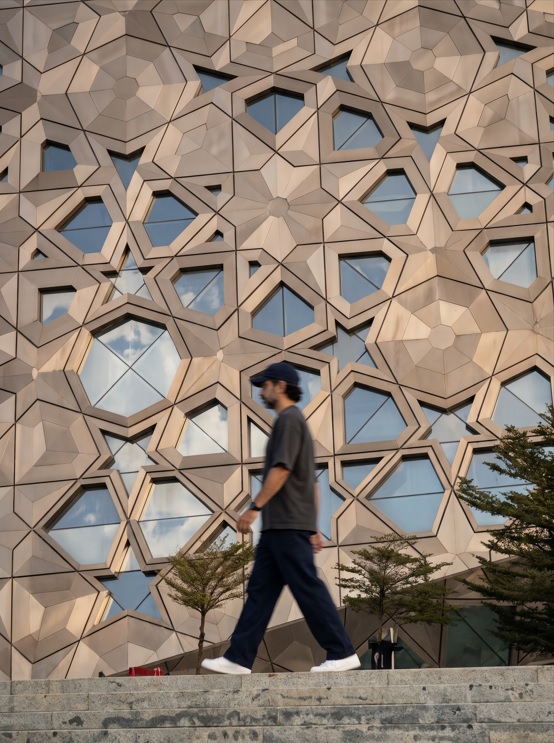
صورتك في مركز جابر الثقافي
#chatgpt

<< Prompt >>
Create a cinematic, hyper-realistic urban documentary photograph that matches the reference image as closely as possible regarding composition, the building, perspective, subject placement, motion blur, lighting, color palette, and framing. Fill the entire frame with the building's façade (maintaining 100% fidelity to the building details in the reference image—no retouching, beautification, reshaping, AI reconstruction, artificial enhancements, or stylistic changes), captured in a precise, direct, head-on view from across the street using a powerful telephoto lens to create a perspective compression effect. The building façade should occupy approximately 90–95% of the image area and extend beyond the left, right, and top edges of the frame; the sky should not be visible. Use a medium-to-long telephoto focal length (equivalent to 105–135mm on a full-frame camera), shooting from a relatively long distance across the street. Avoid any distortion associated with wide-angle lenses. In the immediate foreground, place a man (based on the character sheet in the reference image—maintaining 100% fidelity to features, clothing, and all details; no retouching, beautification, reshaping, AI facial reconstruction, artificial enhancements, or stylistic changes) walking horizontally from left to right across the lower-middle section of the frame. Show him only in profile while walking naturally. The head, shoulders, and body should exhibit strong horizontal motion blur, with no distinct facial details visible. The man should appear large—positioned much closer to the camera than the building—occupying approximately 25–30% of the frame's lower-middle height, with his lower body naturally cropped at the bottom edge of the image. The motion blur must result from a realistic, slow shutter speed rather than an artificial Gaussian blur effect. Maintain a soft yet well-defined silhouette of the head, shoulders, and garment, with edges naturally trailing off in the direction of movement. Lighting: Soft, even, and diffused natural daylight, free from harsh, direct sunlight. Use overcast or hazy late-afternoon lighting conditions so that the entire building receives broad, soft illumination while recessed balconies remain moderately shaded. The use of flash, artificial rim lighting, or harsh, distinct shadows is prohibited. Camera simulation: Professional full-frame camera, 105mm or 135mm telephoto lens, f/5.6 aperture, 1/30s shutter speed, ISO 160, white balance around 5200K; camera stabilized to ensure the building remains sharp while the person's movement appears naturally blurred. Apply soft, documentary-style color grading: moderate saturation, warm earthy midtones, deep shadows retaining detail (no crushed blacks), soft highlights, realistic local contrast, and subtle, natural film grain. Retain architectural imperfections and realistic visual clutter. Avoid over-cleaning the image, excessive beautification, or artificial symmetry correction. Exclude: the sky, modern glass architecture, renovated facades, dramatic sunlight, orange sunsets, HDR looks, artificial depth-of-field blur, a sharp figure in the foreground, frozen walking poses, exaggerated motion trails, CGI surfaces, perfect repetitive geometry, or wide-angle lens distortion. High-quality urban architectural photography, telephoto-compressed facade view, single figure with motion blur